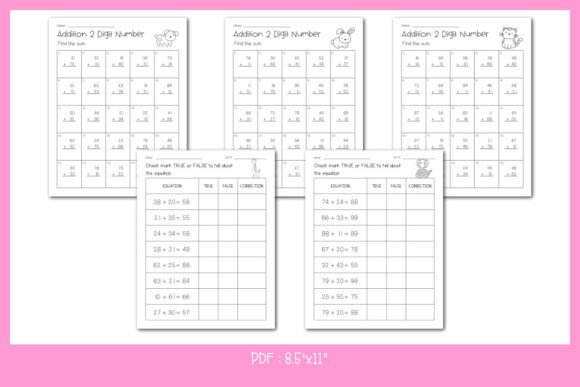
2 Digit Addition No Regrouping: A Guide for Educators and Learners
2 Digit Addition No Regrouping is a foundational math skill that helps students build confidence in arithmetic. It involves adding two numbers, each with two digits, without carrying over any values from one place to another. This concept is especially important for students in grades 2-3, as it lays the groundwork for more complex operations like regrouping and multi-digit addition.
Whether you're an educator, homeschool parent, or someone creating teaching materials, understanding how to teach and practice 2 digit addition no regrouping effectively is crucial. The right resources can make all the difference in helping young learners grasp this essential math skill.
Why 2 Digit Addition No Regrouping Matters
Learning 2 digit addition no regrouping is more than just memorizing steps—it's about developing number sense and problem-solving abilities. When students understand how to add numbers without regrouping, they begin to see patterns in numbers and improve their mental math skills. This is particularly useful when working with money, time, and other real-world applications.
Many educators use worksheets, games, and activities to reinforce this concept. These tools help students visualize the process of adding tens and ones separately, making it easier to grasp the underlying principles.
Common Mistakes and How to Avoid Them
While 2 digit addition no regrouping seems straightforward, there are common mistakes that can hinder learning. One frequent error is misaligning the digits when writing down the problem. For example, if a student adds the ones place first but then forgets to move to the tens place, the result will be incorrect.
Another mistake is confusing regrouping with no regrouping. Some students may try to carry over a digit even when it's not necessary, which leads to unnecessary complexity and errors. It's important to emphasize that no regrouping means each place value is added independently.
To avoid these issues, teachers should provide clear examples and encourage students to check their work. Using visual aids like base ten blocks or number lines can also help students better understand the concept.
Choosing the Right Resources
When selecting materials for teaching 2 digit addition no regrouping, it's essential to look for quality content that is both engaging and educational. Many downloadable worksheets include answer keys, making them ideal for classroom use or home practice.
A resource with 50 fun and thought-provoking scenarios can serve as a supplement to traditional worksheets. These activities challenge students to think critically and apply their knowledge in different contexts. For instance, a worksheet might ask students to solve a word problem involving addition, encouraging them to explain their reasoning step by step.
It's also important to consider the format of the material. PDF files that are ready to print are convenient for teachers who want to distribute handouts quickly. Additionally, having a total of 163 pages ensures that students have ample practice opportunities.
Practical Tips for Teaching and Learning
Teaching 2 digit addition no regrouping doesn't have to be overwhelming. Here are some practical tips to help both educators and students:
- Use Visual Aids: Incorporate charts, diagrams, or manipulatives to demonstrate how addition works without regrouping.
- Practice Regularly: Consistent practice is key to mastering any math concept. Encourage students to complete a few problems daily to reinforce their skills.
- Check for Understanding: After introducing a new concept, ask students to explain it in their own words. This helps identify any gaps in understanding early on.
- Encourage Reflection: Ask students to reflect on their problem-solving strategies. This promotes deeper thinking and helps them recognize patterns in their work.
For students, practicing with answer keys is an excellent way to self-assess their progress. Comparing their answers with the correct solutions allows them to spot mistakes and learn from them.
Realistic Examples and Better Approaches
Let's take a look at a simple example: 24 + 35. In this case, we add the ones place (4 + 5 = 9) and then the tens place (2 + 3 = 5), resulting in 59. This is a classic example of 2 digit addition no regrouping.
If a student mistakenly adds the tens first and then the ones, they might write 2 + 3 = 5 and then 4 + 5 = 9, arriving at the same answer. However, it's important to emphasize the order of operations to prevent confusion later on.
Another approach is to use number bonds or part-whole models to break down the numbers into smaller parts. This method helps students see the relationship between the digits and reinforces the concept of place value.
By using these techniques, educators can ensure that students develop a strong foundation in 2 digit addition no regrouping and are well-prepared for more advanced math topics.
Final Thoughts
2 digit addition no regrouping is a vital skill that empowers students to tackle more complex mathematical challenges. Whether you're looking for worksheets, games, or activities, choosing the right resources can make a big difference in your teaching experience.
With the right guidance and practice, students can master this concept and gain confidence in their math abilities. So, whether you're an educator, homeschool parent, or content creator, investing in quality materials for 2 digit addition no regrouping is a great decision that supports long-term learning success.